
Every investor asks the same question before wiring money overseas.
How safe is this, really?
It’s a reasonable question. Property markets across the world carry varying degrees of legal risk, regulatory uncertainty, and political instability. Some markets that look attractive on a yield basis carry hidden risks that only become visible when something goes wrong.
When it comes to Dubai, the answer is considerably more reassuring than most first-time international investors expect — and is backed by law, institutions, and government architecture, not just marketing claims.
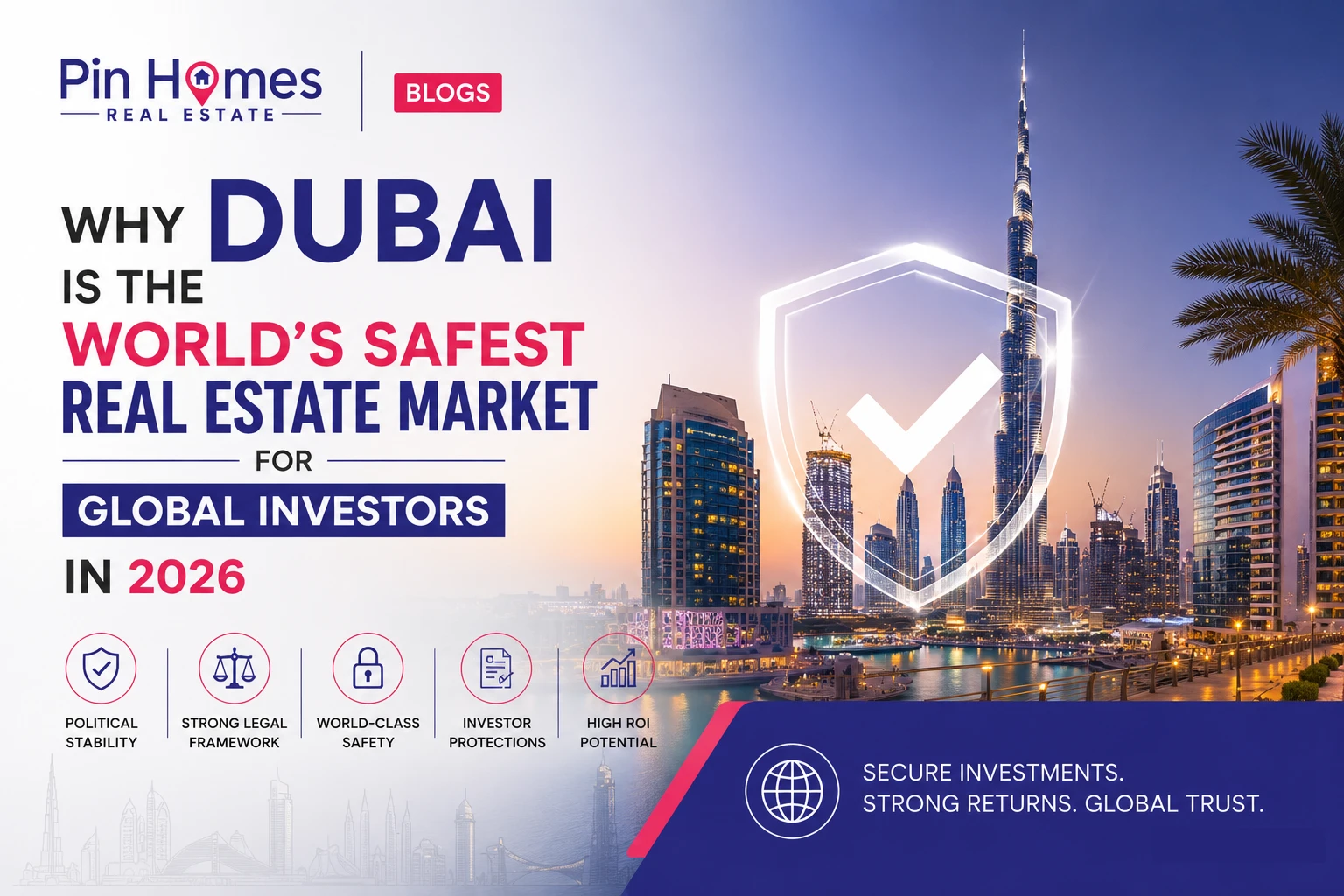
Here’s exactly why Dubai’s real estate market has earned its reputation as one of the world’s most secure destinations for property investment.
A Government That Built Investor Protection Into the Foundation
Dubai didn’t stumble into becoming a global real estate hub. It was engineered to become one — and the legal and regulatory infrastructure reflects that deliberate intention at every level.
The Dubai Land Department (DLD) governs all property transactions in the emirate. Every sale, transfer, mortgage, and ownership registration passes through the DLD and is recorded on a tamper-resistant, government-maintained registry. There is no ambiguity about who owns what. Title disputes that are commonplace in less transparent markets are rare in Dubai precisely because ownership records are centralised, public, and authoritative.
RERA — the Real Estate Regulatory Agency — operates as the enforcement arm, licensing every real estate agent, developer, and project operating in Dubai. No individual or company can legally sell property without a valid RERA registration. Buyers can verify the legitimacy of any agent or project in seconds through the Dubai REST app.
This is structurally different from markets where transactions operate in grey areas, where documentation can be contested, or where ownership records are inconsistently maintained.
The Escrow Law: The Protection Most International Buyers Don’t Know About
One of Dubai’s most significant buyer protection mechanisms is the RERA Escrow Law — and it’s one that consistently surprises first-time international investors.
Under this legislation, all payments made by buyers for off-plan properties must be deposited into a government-supervised escrow account dedicated exclusively to that specific project. Developers cannot access those funds for any other purpose — not for other projects, not for operational expenses, and not for shareholder distributions.
If a developer faces financial difficulties or is unable to complete delivery, RERA has the authority to appoint a new developer to complete the project or to arrange refunds for buyers from the escrow funds.
This single mechanism transformed Dubai’s off-plan market from a faith-based exercise into a legally protected investment structure. It’s a level of buyer protection that many established Western markets don’t offer for new-build purchases.
Full Freehold Ownership for Foreign Nationals
Dubai permits foreign nationals to own property outright and permanently in designated freehold zones — which now include virtually every major residential community in the city.
This isn’t a time-limited lease. It isn’t usufruct rights that expire after 50 years. It’s full freehold ownership — the same legal standing as property ownership in any mature Western market. You can sell, rent, mortgage, gift, or pass your Dubai property to your heirs, as you see fit.
Many countries that compete for international investment don’t offer anything close to this. Thailand limits foreign ownership to apartments and bars land ownership. Vietnam has strict leasehold caps. Several GCC neighbours restrict foreign ownership to specific zones with limited community options.
Dubai offers genuine ownership with a government-registered title deed that carries full legal weight — issued in your name, protected by law.
Transaction Transparency That Most Markets Can’t Match
One of the most meaningful markers of a trustworthy real estate market is data transparency.
In Dubai, every property transaction is recorded by the DLD and the data is publicly available in near real-time. Actual sale prices — not asking prices, but what properties genuinely transacted for — are accessible through the DLD transaction register and major portals. This means you can independently verify whether the price you’re being asked to pay reflects actual market conditions, not developer or agent-inflated claims.
This level of transparency is remarkably uncommon globally. In many European markets, actual transaction prices are not publicly disclosed. In several Asian markets, price data is opaque and frequently manipulated. In India, stamp duty undervaluation means recorded prices often don’t reflect actual transaction values.
In Dubai, what you see is what the market actually paid.
Political Stability, Currency Peg, and Long-Term Strategic Vision
Dubai operates within the UAE — one of the world’s most politically stable environments. The UAE government has maintained decades of consistent economic policy focused on diversification, infrastructure investment, and positioning the UAE as a global business hub.
The UAE Dirham has been pegged to the US Dollar at AED 3.67 since 1997 — nearly three decades of currency stability. For investors whose home currencies have experienced significant volatility (Indian Rupee, Pakistani Rupee, British Pound, Euro), this peg provides a meaningful hedge against currency risk on their investment.
Dubai’s 2040 Urban Master Plan targets a population of 5.8 million and designates five major urban centres for sustained development. This isn’t a speculative vision — it’s a government-funded, actively implemented roadmap that creates long-term structural demand for the property the plan encompasses.
Zero Property Tax — By Law, Not Just Policy
It bears repeating because of the compounding impact it has on investment returns: Dubai currently levies no annual property tax, no rental income tax, and no capital gains tax on property transactions.
The one-time cost is the 4% DLD transfer fee paid at purchase. In the majority of established Dubai communities, this is recovered within approximately 12 months of rental income.
From that point forward, your investment operates in a tax-free environment. Every dirham of rental yield, every dirham of capital appreciation on sale, remains entirely yours.
What “Safe” Means Across Every Dimension
Safety in real estate investment means different things to different investors:
- Legal clarity of ownership ✔ Dubai delivers through the DLD title registry
- Protection from developer default ✔ Dubai delivers through the RERA Escrow Law
- Regulatory oversight of agents ✔ Dubai delivers through mandatory RERA licensing
- Transaction price transparency ✔ Dubai delivers through public DLD data
- Currency stability ✔ Dubai delivers through the USD peg
- Political stability ✔ Dubai delivers through consistent, long-term governance
Dubai performs strongly across every dimension of investment safety — more comprehensively than many markets with far longer histories.
Start Your Dubai Investment with the Right Guidance

Pin Homes Real Estate LLC guides first-time international investors and experienced global buyers through every stage of the Dubai property market.
We help you understand your legal protections, identify reputable developers, evaluate communities, and make investment decisions grounded in verified market data — not speculation or hype.📞 Book a consultation: +971 58 529 3432 🌐 pinhomes.ae/contact-us
Disclaimer: This article is for informational purposes only and does not constitute financial, legal, or investment advice. Property prices, rental yields, and market figures mentioned are approximate and subject to change. Always consult a qualified professional before making any property or investment decision. Pin Homes Real Estate LLC is a RERA-licensed real estate agency in Dubai, UAE.



18 Things to Know Before Moving to Dubai — The Honest Guide for New Arrivals in 2026

11 Brilliant Teacher Discounts in Dubai You Should Be Using Right Now
